 Laniz Nooshkevins Lumu
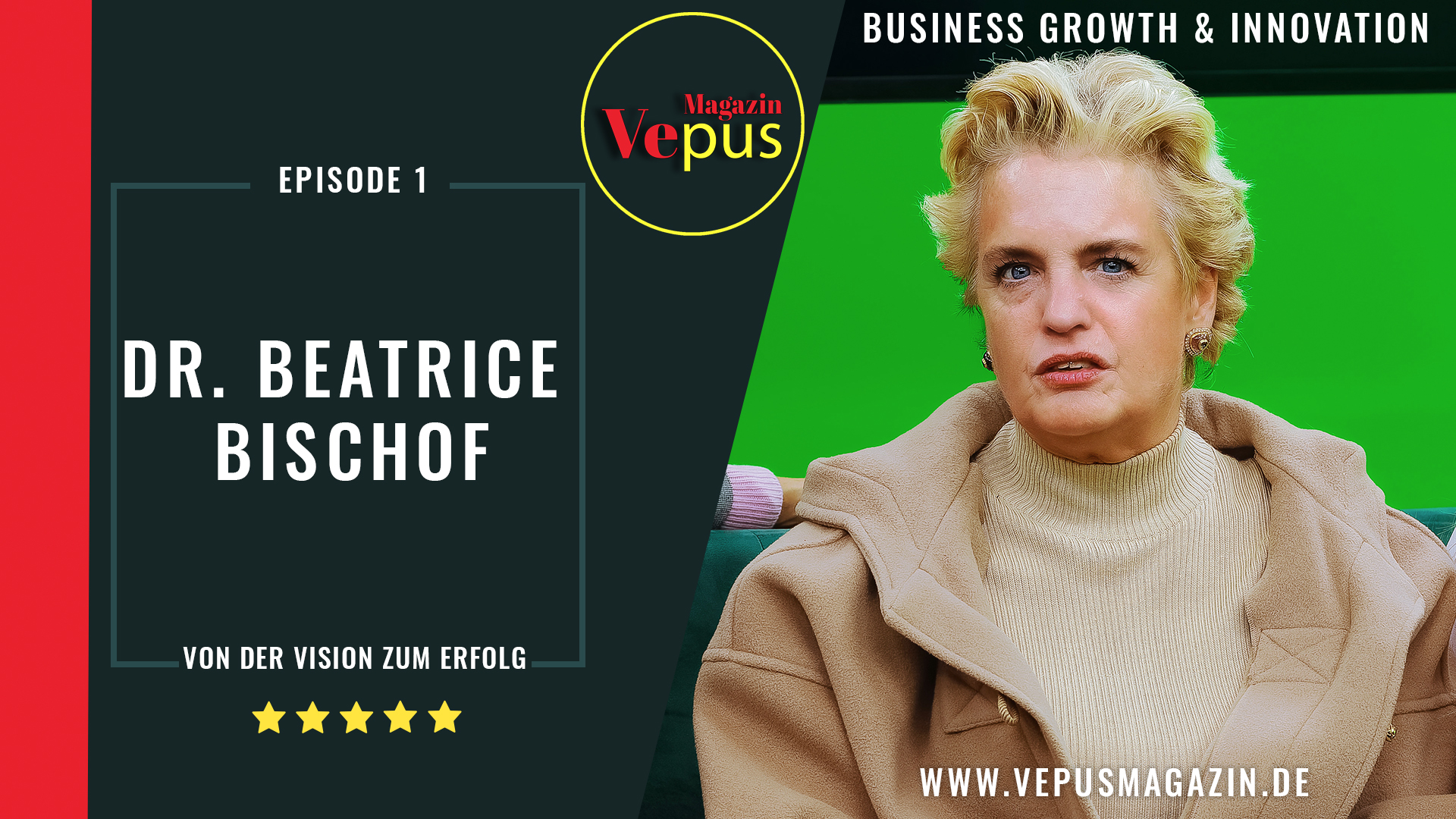
How does strategic foresight emerge in a world that is changing faster than ever? In the new VEPUS MAGAZIN interview, presenter Diana Marisa Brachvogel talks with Dr. Beatrice Bischof, International Strategic Advisor and strategy consultant, about a thesis that is becoming increasingly important for entrepreneurs and executives: foreign policy, technology and business can no longer be considered separately.
Who is Dr. Beatrice Bischof?
Dr. rer. pol. Beatrice Bischof is an International Strategic Advisor, strategy consultant, journalist, speaker and author based in Munich. She studied political science, public law and literature at Ludwig-Maximilians-Universität München, where she also earned her doctorate with a minor in economic and social history. In addition, she completed further training at the Massachusetts Institute of Technology (MIT) in New Space Economy.
Her career combines entrepreneurship, media and international politics: until 1996 she was a member of the management board of the long-established family business; she then trained as a TV journalist and worked as a television editor, political scientist and publicist. Today, through Starclimber she strategically advises start-ups and technology companies.
- 25 years on the board of the German Council on Foreign Relations (Gesellschaft für Außenpolitik) in Munich
- Columnist at The European
- Four years on the board of Women in Tech bei EUTECH – The European Technology Chamber
- German representative of the Mohammed Bin Rashid Aerospace Hub in Dubai
- Commitment to women in technology and leadership

Why foreign policy, technology and business belong together
For a long time, foreign policy was considered the business of diplomats, technology the domain of engineers and the economy the field of entrepreneurs. This division of labour no longer holds. Supply chains, energy supply, data regulation, export controls or access to key technologies are today geopolitical, technological and entrepreneurial questions at the same time. Anyone who runs a company therefore also makes decisions relevant to foreign policy – consciously or unconsciously.
Dr. Beatrice Bischof starts precisely at this intersection. Her approach: strategic quality does not come from ever deeper specialisation, but from the ability to connect different disciplines. In management research, this idea is known as Boundary Spanning – the ability to bridge boundaries between disciplines, organisations and cultures. Especially in phases of high uncertainty, it gives companies a measurable advantage, because risks are recognised earlier and opportunities seized faster.
Strategy begins where disciplines meet.
Guiding idea of the interview with Dr. Beatrice Bischof
The key topics of the interview
1. International politics as an economic factor
Geopolitical developments have a direct impact on markets, investments and location decisions. The conversation makes clear why entrepreneurs – from SMEs to start-ups – should not only observe political developments, but systematically integrate them into their strategy. Scenario planning and political risk analysis have long ceased to be tools reserved for large corporations.
2. Strategic advice for start-ups and tech companies
Young technology companies often have excellent products but little access to international networks, decision-makers and markets. Through Starclimber, Dr. Bischof supports founders and tech companies in positioning their innovations strategically – and shows why a resilient network is often as valuable as capital.
3. Interdisciplinary innovation and international exchange
Innovation happens where politics, business and technology enter into dialogue. Dr. Bischof describes how interdisciplinary formats – from round tables to international conferences – bring together players who rarely meet in everyday life, thereby opening up new solution spaces.
4. Digitalisation and sustainability as strategic success factors
For Dr. Bischof digitalisation is not an IT project but a driver of economic transformation. She sees sustainability not as a box-ticking exercise but as a strategic success factor that helps determine competitiveness, financing and employer attractiveness.
5. New Space Economy – the future of the space industry
Space travel has evolved from a state-dominated field into a dynamic market with private players. Satellite data, communications and Earth observation create new business models – even for companies that will never build a rocket themselves. As German representative of the Mohammed Bin Rashid Aerospace Hub in Dubai, Dr. Bischof knows the international dynamics of this future market first-hand.
6. Women in technology and leadership
Another focus of the conversation is the role of women in technology and leadership positions. Diverse teams demonstrably make more balanced decisions – yet women remain under-represented in tech companies and boardrooms. Dr. Bischof shows why visibility, networks and role models are crucial.
7. The future of work and education
When technologies and markets change ever faster, education must change too. Lifelong learning, interdisciplinary knowledge and international experience are becoming core competencies – for employees and executives alike.
What entrepreneurs and executives can take away
- Geopolitics belongs in strategy: Political developments should be an integral part of risk and growth planning.
- Connect disciplines: The best solutions emerge at the intersections of politics, business and technology.
- Build networks strategically: International exchange opens up markets, perspectives and partnerships.
- Understand future markets early: Fields such as the New Space Economy offer opportunities far beyond space travel.
- Use diversity as a strength: Diverse teams and female leadership increase the quality of strategic decisions.
Those who want to shape the future must think across boundaries.
Guiding idea of the interview
Conclusion: strategy in a changing world
The interview with Dr. Beatrice Bischof shows that strategic foresight today is above all a question of perspective. Those who think foreign policy, technology and business together recognise developments earlier, make better-founded decisions and position their company more resiliently for the future. A conversation for everyone who wants not just to react, but to shape.
Watch the full interview now: Dr. Beatrice Bischof on VEPUS MAGAZIN on YouTube. Learn more about Dr. Beatrice Bischof on her website beatricebischof.com.
Presenter: Diana Marisa Brachvogel · Production: LANIZMEDIA · VEPUS MAGAZIN – Conversations That Shape The Future.